 Code from Spec
Part I — The primitives
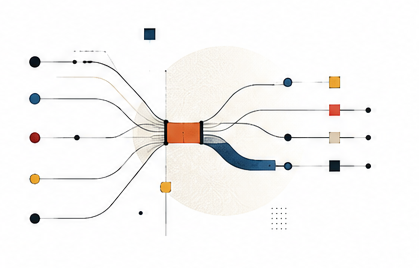
The apparatus has six parts.
- A space of texts: every text that could be written. Programs live here, along with the broken attempts at them (the space has no admission test) and a project's other writings, its tests and specs included. What makes a text a program is conformance to a language's rules, and the apparatus treats that conformance like any other property: something a verdict decides, not something the space guarantees.
- An intent: what the system is actually supposed to do, held by the people who need it, known incompletely even to them, revised on contact with reality.
- A description: anything that narrows the space to a region of acceptable programs — a spec, a type system, a ticket, a convention nobody wrote down but everybody enforces in review. A description does not have to be written down to count; it only has to constrain. Each one is an encoding of intent, finite and authored, so the region it defines and the region intent would accept are two objects that are meant to coincide but never quite do.
- A generator: any process that, given a description and a context, produces a text. Context here means the rest of what conditions the draw: the existing artifact, a failed candidate, whatever the generator happens to see. The generator is a distribution over the space, sampled once per invocation. Even before any description narrows it, that distribution is nowhere near even: a generator's training already concentrates almost everything it will ever produce in a vanishingly small, highly conventional corner of an otherwise limitless space. That concentration — what the generator is inclined to write before any description says a word — is its prior. Pre-training rewards predicting what a vast body of real code made likely; post-training laid over it rewards following instructions — that is why a description can steer it at all.
- An oracle: any procedure that decides, on whichever dimensions it covers, whether a point belongs to a region. The region may be the one the description defines or the one intent would accept; an oracle can answer to either.
- The artifact: the program you actually have, one point in the space, carrying whatever evidence of survival it has accumulated — tests it has passed, traffic it has served, incidents it has not caused.
The description's job is aiming. It conditions the distribution the generator samples from, shifting draws toward the region it describes. Aiming is statistical: a good description makes landing outside the region unlikely, not impossible, and the generator remains free to miss on any single draw. A clause saying withdrawal amounts must be positive makes drawing a program that accepts a negative one rare, but cannot make it impossible.
The oracle's job is confirming. Confirming is bounded rather than statistical: it decides membership by checking specific properties. The test built from that clause fails the negative-amount program every time, and says nothing about any dimension it does not assert. Passing every check an oracle can run is not the same as belonging to the region; it is the narrower claim of conforming on the dimensions the oracle happens to check.
The two jobs also differ in what they can reach. Generation produces text, and nothing executes during a draw. Yet most regions are defined by behavior — by what a program does when run — and behavior enters the apparatus only through an oracle.
Four operations act on these parts.
- Sampling: produces a fresh point from the generator.
- Local move (a diff or patch): a draw conditioned on the existing point — some dimensions re-decided, the rest meant to be inherited as they are. The inheritance is an aim like any other, not a guarantee.
- Resampling: sampling with something to discard. A fresh draw, independent of the last, that throws away the existing point and whatever survivor evidence it carried. The draw is the same operation as sampling; the discard is where the cost lives.
- Ratifying: moves a discovery from the environment into the description or the oracle, so that future samples are constrained by it rather than left to get it right by luck.
Nothing about the operations enforces the description's presence. A draw is conditioned on whatever happens to be in its context, and the description aims only when it is there.
Local move and resample are ends of one scale rather than different kinds of thing. Every change to software is a draw, and what varies is how much of the existing point conditions it. That amount of conditioning is also the apparatus's working measure of relatedness: what two points share is what one inherited from the other, defects included.
Underneath all four operations sit two prices and a tendency, and together they decide which operation is rational at any moment. The prices are the cost of generating a candidate and the cost of checking it against the oracle. The tendency is anchoring. A local move is conditioned on the existing point, and the point does not merely provide context; it captures the draw, pulling resolutions toward what already exists rather than what the description asks for. Ratifying runs on a price of its own: authoring an encoding, and carrying it afterward.
The checking price deserves a note: it is not flat across the scale of operations. A draw obligates confirmation of whatever it re-decided, so a local move prices its check by the size of the change, while a resample re-opens every dimension at once. Wherever the verdict comes from an expensive oracle (a human reading the candidate is the common case), that difference is most of what the operation costs.
That is the whole apparatus.
A small example to illustrate. The intent: display dates readably for Brazilian users. The description: "format dates as DD/MM/YYYY." A generator produces a function that does so, and zero-pads single-digit days, because that is what date-formatting code in its training data overwhelmingly does. Nobody stated zero-padding; the prior resolved the silence. The oracle (a test checking that June 5th renders as "05/06/2025") confirms the dimension it covers and says nothing about what happens at midnight, at locale boundaries, or with invalid input. The artifact is the function that exists, carrying those resolutions and that one piece of evidence.
The dimensions that do and do not matter
The space of texts has far more dimensions than intuition expects. Moving along most of them does not change program behavior at all (a renamed variable, two independent statements reordered), while a few carry outsized, catastrophic sensitivity: flip a comparison operator, shift a loop bound by one, and a single-token edit lands the artifact in a different region entirely. Behavior is one axis; cost is another, and they are independent. A dimension can be behaviorally free (it never changes which programs conform) and still cost-relevant: it moves the price a human pays to confirm a candidate, the price a future editor pays to understand the artifact well enough to aim the next change, and the odds of a local move touching a dimension that does matter. Naming is the standing example: it is behaviorally free (reflection, serialization keys, and a public API's own symbols are the exceptions) and expensive everywhere else.
What a bug is
Given these primitives, a bug has a precise shape, and it comes in three kinds worth telling apart, because the remedies differ.
The first kind is nonconformance. The description ruled on the dimension in question, and the sample still landed outside the region it defined. This is a plain generation error: the aim was adequate, the draw missed anyway. A faithful oracle catches it whenever it covers that dimension, and the catch is mechanical, not statistical. When it slips through regardless, the gap is in the oracle's coverage, not in the description.
The second kind is underspecification. The description never ruled on the dimension at all, and the generator resolved it however its own prior favored. Most such resolutions are harmless: the behaviors compatible with the silence mostly overlap with what the stakeholders would have accepted, had anyone thought to ask. A bug, on this reading, is the case where the prior resolved a silence against intent: the sample is fully conforming to everything the description said, and still wrong, because the description never said enough to rule the outcome out.
The third kind breaks an assumption the first two share: that where the description ruled, it ruled for intent. Mis-specification is the case where it did not. The description ruled on the dimension and ruled wrong, so the sample conforms exactly and is a bug anyway. No oracle built from the description can catch it, since the two agree by construction. The verdict has to come from something that answers to intent directly: a stakeholder seeing the behavior, perhaps production itself. From inside a single incident this is indistinguishable from the case where intent has moved since the description was written: the same report, "the spec is wrong," with only the history deciding whether the description was wrong from the start or the target moved after it was written.
One scenario holds all three kinds. A description says an invoice is due thirty days after issue, and the generator writes thirty calendar days — while the business, had anyone asked, counted business days. Every check derived from the description passes; the sample conforms to everything the text said; the bug is real anyway. That is underspecification in one line. Had the description said business days and the sample added calendar days regardless, the same wrong program would be nonconformance; had the description itself said calendar days because its author misread the policy, mis-specification. One diff, three different repairs.
The three kinds determine the fix. A nonconformance the oracle catches at the draw needs no repair: the loop redraws, and the apparatus is working as built. The nonconformance that constitutes an incident is the one that slipped through, and its repair is extending the oracle to catch the violation mechanically. The defective artifact still has to be replaced — a redraw, since the miss was bad luck, not bad aim — but the redraw is remediation, not the fix: without the extended oracle, whether the new draw conforms on that dimension cannot even be confirmed.
Underspecification is repaired by narrowing the description along the dimension the incident just revealed, and in the same motion teaching the oracle to check it, so the fix holds even after the code that currently embodies it is gone. This is the operational meaning behind "the fix goes into the spec and a test pins it": one clause narrows the aim, the other closes the oracle's blind spot on that one dimension. Only doing both makes the correction durable across a resample instead of true only of the current point.
Mis-specification is repaired by neither: not another draw, not a narrower region, but re-authoring — correcting what the description says.
This also splits ratifying in two, showing it was never merely the recording of a decision after the fact. Ratified into the description, a discovery narrows the region retroactively: the point a sample just proved reachable and unwanted no longer conforms, so the discovery is intent folded back into the text that was supposed to have contained it from the start. The exclusion is certain only as a matter of membership. Whether future draws respect it is aim, and aim is probability: a draw can still miss the narrowed region, and only a check can say whether it did. That is what the second destination is for: ratified into the oracle, the same discovery widens what can be confirmed. A cheap check now covers the dimension an expensive incident just visited, and that verdict never has to be bought at that price again.
Oracles and descriptions
Mis-specification exposed a divide that deserves its own name, because it classifies oracles as much as it classifies bugs. An oracle is either description-facing or intent-facing, depending on which object its verdict answers to. A test built from the spec faces the description; a stakeholder reacting to behavior faces intent, and so does production itself. Which one an oracle is decides what it can ever catch: a description-facing oracle catches nonconformance and passes the other two kinds through certified (it agrees, by construction, with the description it was derived from), while underspecification and mis-specification are judged only by a verdict that answers to intent directly.
The divide also contains an equivalence, a lossy one: a description and a description-facing oracle are the same kind of object — a finite, authored encoding of the region — in two different modalities. The description is the encoding stated, so it can aim a draw before it happens; the oracle is the encoding made executable, so it can decide a candidate after it exists.
Each form can be derived from the other, imperfectly. A test gets written from the description, but the why does not survive the translation: the clause that forbids negative withdrawals because a negative withdrawal would credit the account — a deposit dodging the audit trail — arrives as an assertion that withdraw(-50) must be rejected, the rule intact and the reason gone. A test can be read back as a statement, and only the checked slice comes out: of everything the description said, or meant by staying silent, the reading recovers just the dimensions some assertion touched. The mutual derivability is what lets a discovery enter ratification through either form; the loss in each direction is why it should enter through both.
The oracle's definition hides something the equivalence brings out. As defined it is a black box (artifact in, verdict out) and a bare pass/fail says almost nothing about the region's shape: one bit per point checked. In practice, no oracle anyone writes stays that opaque. A test is authored from a named property and read as one; when it fails it does not return no, it returns withdrawal amounts must be positive, and this one was not. That is a description clause, stated in the act of confirming. A real oracle leaks description whenever it is written or read, because it was a description the whole time, in executable form.
This is what "tests, not specs" leaves out. A test suite offered as the whole account, with no spec beside it, is not free of description; it is description fused to its oracle and passed off as only the oracle. Every assertion is a clause; the why each clause carries is left unsaid. Much of what follows still treats the oracle as the pure decider its definition names, because confirming is the role the theory needs from it. But the oracles of real projects are descriptions too, and carry what any description carries: the silences, the lost why, and the aim exerted on whatever draw later reads them.
Intent-facing oracles sit outside the equivalence: no authored encoding can stand in for the stakeholder. But their purity is a limit, not a state: the verdict's source is intent; the channel it arrives through is authored. Production speaks through monitoring, thresholds, and whoever files the report; a stakeholder reacts to the slice of behavior a demo chose to show, against expectations the last description planted. An intent-facing verdict is consumed through description-facing instruments, and the instruments carry everything an encoding carries: blind spots, silences, the possibility of measuring the wrong thing. The purest verdicts are the unfiled ones, which is why they so rarely arrive.
Anchoring
Anchoring is not a property of the artifact alone; it takes three participants. The point provides the attractor: it is what sits in the context, available to be mimicked. The generator determines the strength of the pull, how readily it reproduces what it sees over what it is told. And the description determines the counter-force, how explicitly and forcefully it demands departure from what exists. Anchoring is the outcome when the attractor wins, and it shows up in one observable comparison: the description says one thing, the draw delivers the neighborhood of the current point instead. When anchoring is weak, the description governs and local moves land where it aims; when anchoring is strong, the artifact governs regardless of what the description asked for.
The three participants meet in one place: the context. To the generator there is no privileged channel — the description, the existing point, a failing test all arrive as one body of text — and whatever authority the description is supposed to hold over the artifact is not intrinsic to the draw. It has to be carried by the presentation. What order the two arrive in, whether a changed clause is marked as changed or left for the generator to discover, whether the old point is framed as the thing to rewrite or reads as the latest word: each of those choices moves where the draw lands. Anchoring is a property of the assembly as much as of the parts: the same description and the same artifact, presented differently, anchor differently.
The subtlest channel of capture runs through the silences. The description leaves dimensions open; the artifact, by existing, has resolved every one of them. Present both, and the generator does not meet an open question with one candidate answer beside it — it meets no open question at all. The silence arrives pre-answered, and nothing in the context marks the answer as provisional. A resolution made under a spec that has since moved, or wrong from the start, reads exactly like a decision. This is anchoring at its most defensible-looking: resolving uncertainty from available evidence is what a good generator should do, and that is what makes it hard to catch.
None of this is specific to models. A human maintainer holding a spec and an artifact defers the same way: where the code answers a question the spec left open, the resolution is presumed deliberate. The presumption is trained, not lazy. Engineering culture codified it as prudence: follow the existing conventions, do not rewrite what works, do not remove the fence until you know why it stands. A model trained on human code and human instruction-following inherits the same deference, and it would be strange if it did not. Which is also why the counter-force is not a new invention: the diff, the changelog, the migration guide are the presentation problem solved for human generators — tell the next reader what changed, so that nothing has to be discovered against the pull of what already exists.
That the pull has three sources is what makes it workable. The point cannot be argued with; it is whatever the project currently is. The generator's habits arrive fixed with the generator. The counter-force is the description, the one participant that is authored, which makes it the first lever to reach for when a draw comes back captured: say what changed, mark what moved, demand the departure explicitly. Only when a re-armed description still loses does the point itself have to go.
One route around all of this presents itself immediately: never show the generator the old point. Regenerate from scratch on every change, always greenfield, and anchoring cannot occur, because the attractor was never in the context. The price of that route is the one the operations' costs already named: every draw pays the resample's bill. A methodology that takes it has not solved the presentation problem; it has arranged never to face it. How description and artifact are best presented together, so that the point informs the draw without capturing it, is an open question, and one of the hardest an honest spec-driven practice owns.
Comments
Under human maintenance, comments were a dimension like naming: behaviorally free, cost-relevant, priced entirely at reading time. A generation loop changes their status. The next draw reads them as context, and a comment aims it the way a clause in the description would — a fragment of description embedded in the artifact. Nothing that polices the description polices the fragment: no oracle checks a comment, no test fails when it goes stale, and the loop that visibly punishes a broken clause ignores a broken explanation. A stale comment keeps aiming after it has stopped being true.
A generated artifact holds two kinds of comment. The first kind is authored: it restates a decision the description already holds, transported into the artifact so it is read at the point of use, re-emitted on every draw, and mechanically checkable the way a license header or a required safety notice is checked. The second kind is generated: the generator resolves a silence and adds a justification for its own resolution.
To the next draw the two kinds arrive indistinguishable, because to a generator no channel is privileged. Yet the second kind records no decision — its resolution is whatever the prior favored on that draw, and its justification is written after the fact — and it aims every draw that reads it all the same. Anchoring names the danger: the subtlest capture was the silence arriving pre-answered, and a generated justification goes a step further and marks the answer as deliberate.
This resolves an old maxim. "Comments explain why, not what" got the content right and the location by necessity: with no durable description, the artifact was the only place a why could be recorded. The apparatus removes that constraint: a reason worth keeping is ratified into the description, where every future draw is aimed by it on purpose. What survives in the artifact shares the comment's syntax without being one — a description clause in transit, or generated text with no authority of its own. The comment properly so called, discretionary prose whose only record is the artifact, is the one kind a sound workflow does not keep: it is a ratification still pending, stored in the one place a resample erases.